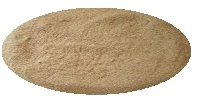
High Protein Castor De Oiled Cake - Organic Fertilizer
High Protein De-oiled castor cake is also called castor meal, castor cake, castor residue or castor extract.
Castor meal - the residue obtained from castor oil cake by the solvent extraction process - is one of the most versatile natural manures. It is truly organic manure which enhances the fertility of the soil without causing any damage or decay. It is enriched with the three big elements vital and conducive to the proper growth of crops - Nitrogen, Phosphorus and Potassium.
Nutrient content of High Protein Castor De Oiled Cake:
Organic matter ~ 80 %, Nitrogen ~ 5.00 to 8.00 %, Phosphorous ~ 1.50 %, Potassium ~ 1.50 %.
It also contains some micro nutrients viz., Calcium, Magnesium, Sulphur, Iron, Zinc, Manganese, Copper etc.
A typical composition of High Protein Castor De Oiled Cake is as follows:
Castor De Oiled Cake (High Protein)
Nitrogen - 6% min.
Protein - 38% min.
Phosphourous - 1% min.
Potassium - 1% min.
Moisture - 12 % max.
Oil Content - 0.5% max.
Sand Silica - 2% max
Castor De Oiled Cake (SPL High Protein)
Nitrogen - 8% min.
Protein - 50% min.
Phosphourous - 1% min.
Potassium - 1% min.
Moisture - 12 % max.
Oil Content - 0.5% max.
Sand Silica - 2% max
Advantages:
1. It provides all the major & minor nutrients necessary for better plant growth.
2. It also helps in increasing the nutrient uptake by plants.
3. It improves the soil fertility and productivity.
4. It is known to protect the plants from nematodes and termites.
5. It improves the yield & quality of the farm produce.
6. It improves the physical, chemical and biological properties of soil.
7. It has insecticidal properties and naturally pest repellent.
Mode of use
High Protein Castor De Oiled Cake fits for any type of soil, with its high content of organic matter. Sunray International recommends this manure for all kind of crops. High Protein Castor De Oiled Cake is also the fertilizer for turf and lawns.
When it is used as basic manure, High Protein Castor De Oiled Cake is taken by spreading on the soil 10 to 15 days before planting. When used as a fertilizer for maintenance, it is spread to the surface, slightly hidden if possible, and lightly watered if necessary.


 Added (m.d.y): 02.14.2019
 Neem De Oiled cake (Neem Cake) - Organic Fertilizer
Neem De Oiled Cake commonly called as Neem DOC, Neem Meal & Neem Cake.
Neem De Oil cake is ...
Neem De Oiled cake (Neem Cake) - Organic Fertilizer
Neem De Oiled Cake commonly called as Neem DOC, Neem Meal & Neem Cake.
Neem De Oil cake is ... Click here to contact this member